
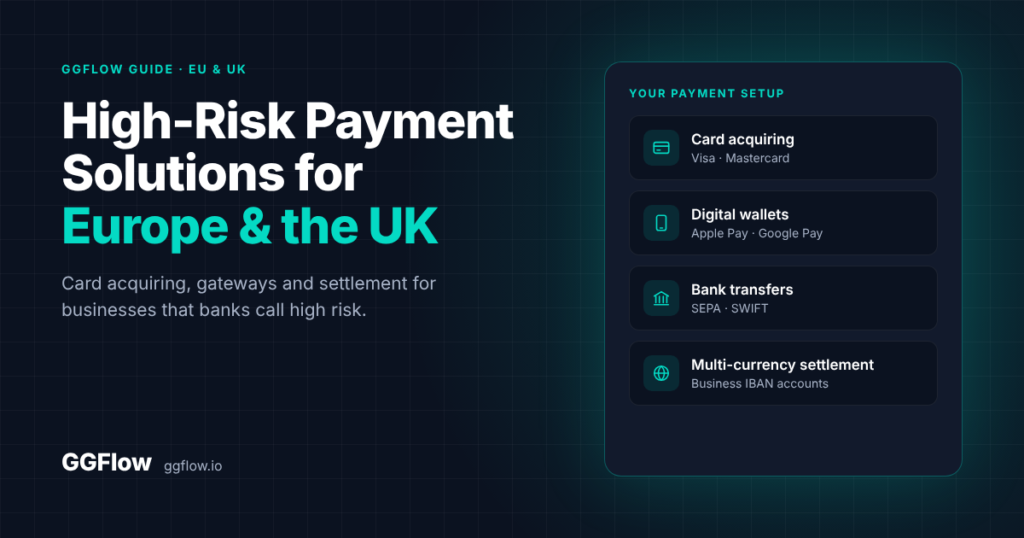
If your business sells supplements, CBD, vapes, adult content or other products that banks label “high risk”, you already know the pattern. The mainstream checkout works for a few weeks, then an account review arrives, funds are held, and the account closes. High-risk payment solutions in Europe and the UK exist to stop that cycle: they connect you to acquirers and payment providers that knowingly accept your business model, on terms you see before you go live.
This guide explains what “high risk” means to a payment provider, what a working setup looks like in 2026, and how GGFlow helps merchants build one across EU and UK markets.
What makes a business “high risk” to a payment provider?
A provider classifies risk by looking at how likely it is to lose money or break rules through your account. Four factors drive the label.
- Chargeback exposure. Subscriptions, free trials and products with delayed results attract more disputes.
- Regulatory complexity. Products such as CBD, vapes and adult content sit under sector rules that change often.
- Card scheme rules. Visa and Mastercard set extra registration and monitoring duties for some categories.
- Reputational risk. Some banks simply avoid certain sectors as a matter of policy.
Mainstream platforms publish these limits openly. Stripe’s own list, for example, prohibits adult content and services and restricts CBD. A merchant who signs up anyway is likely to be closed once the products are reviewed. The answer is not to hide what you sell; it is to work with providers who accept it.
Which industries count as high risk in the EU and UK?
The list varies by provider, but these sectors are classified as high risk almost everywhere:
- Nutraceuticals and dietary supplements, especially on subscription models
- CBD and hemp-derived products
- Vapes and e-cigarettes
- Adult content and adult products
- Peptides and other products near the line between cosmetic, supplement and medicine
- Travel, dating, and online education with long delivery windows
Each sector has its own rules. We cover them in detail in our guides to peptide payment processing, nutraceutical and supplement payments, CBD payment processing, adult payment processing and vape payment processing.
The parts of a high-risk payment setup
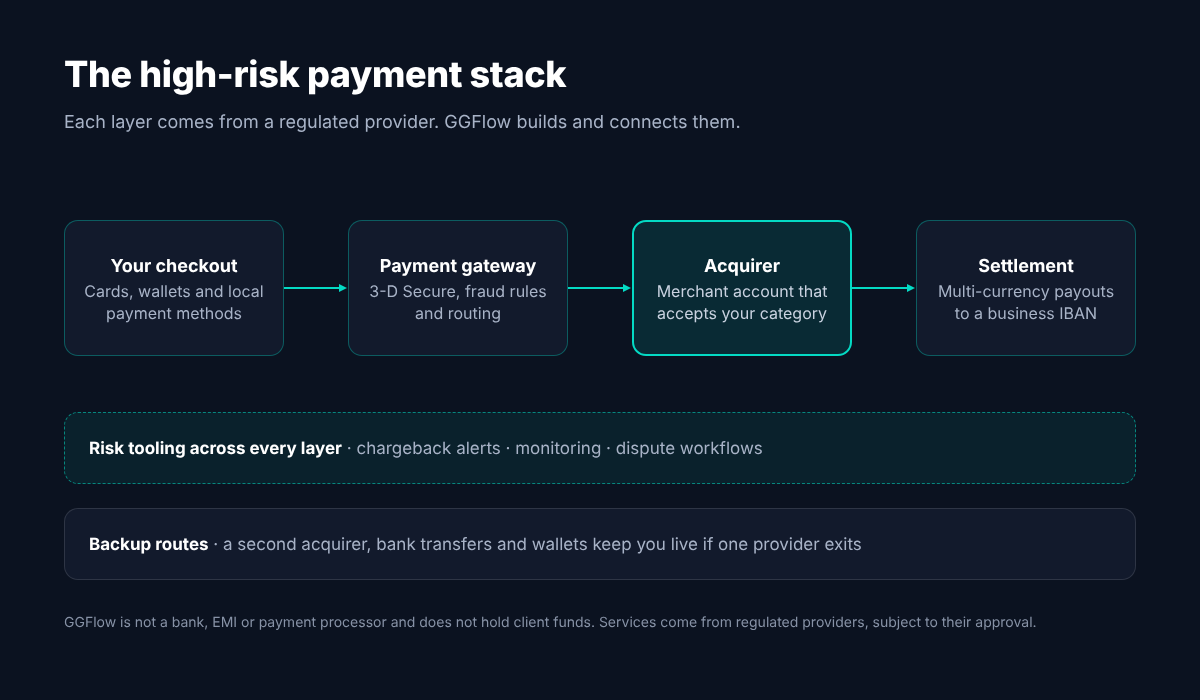
A reliable setup is more than one merchant account. It is a stack of connected pieces, each provided by a regulated firm.
[In-blog image: high-risk-payment-solutions-europe-uk-graphic.png — “The high-risk payment stack” diagram] Alt text: “Diagram of a high risk payment setup: checkout, gateway, acquirer, settlement account”
- Acquiring (the merchant account). An acquiring bank or licensed payment institution lets you accept Visa and Mastercard. This is the hardest piece to secure and the one that most often fails.
- Payment gateway. The gateway carries card data from your checkout to the acquirer, runs 3-D Secure, and applies fraud rules.
- Alternative payment methods. Apple Pay, Google Pay, SEPA and SWIFT bank transfers, and local methods in your target markets lift conversion and reduce reliance on cards alone.
- Settlement and banking. Funds land in a business IBAN account, often with an electronic money institution (EMI), and can be settled in several currencies.
- Risk tooling. Chargeback alerts, monitoring and dispute workflows keep your ratios inside scheme limits.
GGFlow works on every layer. We help merchants accept card payments, Apple Pay, Google Pay, local methods and bank transfers, and we connect multi-currency settlement and business IBAN accounts through selected EMI partners. GGFlow is not a bank, EMI or payment processor and does not hold your funds; each service comes directly from the regulated provider, subject to its approval and checks.
High-risk merchant account vs payment gateway: what’s the difference?
Merchants often use the two terms as if they mean the same thing. They don’t.
| High-risk merchant account | High-risk payment gateway | |
| What it does | Lets you accept card payments and receive the money | Moves payment data securely between checkout and acquirer |
| Who provides it | Acquiring bank or licensed payment institution | Gateway provider, sometimes the acquirer itself |
| What it decides | Whether you are approved, your fees and any reserve | Checkout experience, fraud rules, 3-D Secure |
| If it fails | You cannot take card payments | You can switch gateway and keep the account |
You need both. A gateway that supports several acquirers gives you a backup route if one acquirer changes its appetite.
What high-risk providers check before approving you
Every regulated provider in Europe runs know-your-business (KYB) and know-your-customer (KYC) checks. For high-risk merchants the review goes deeper. Expect to provide:
- Company registration documents and ownership details for every beneficial owner
- A live, complete website with clear terms, refund policy, contact details and product descriptions
- Proof that your products are legal in each market you sell to
- Processing history, if you have it, including chargeback and refund ratios
- Expected monthly volume and average order value
- Source of funds and supplier invoices on request
GGFlow’s compliance support covers the follow-up work: answering requests for information (RFIs), source-of-funds questions, invoices and other provider requests. Every project is reviewed before onboarding, so we only take setups forward where we believe a provider can approve them.
What does high-risk payment processing cost?
Pricing depends on your sector, volume, history and the markets you sell into. Instead of quoting averages that won’t apply to you, here is what to ask for in writing before you sign:
- Setup fees for the account and integration
- Processing fees per transaction, split by card type and region
- Settlement fees and currency conversion costs
- Chargeback fees per dispute
- Rolling reserve, if any: the percentage held and the release period
At GGFlow, you receive the full commercial terms before onboarding, and no fees are added after you approve the offer. A rolling reserve is not automatic. Some acquirers require one and others don’t; where a reserve applies, its percentage and release period are confirmed before you start.
Chargebacks: the number that decides whether you stay live
Card schemes watch every merchant’s dispute and fraud levels. Visa’s Acquirer Monitoring Program (VAMP) combines fraud reports and disputes into one ratio. On 1 April 2026, Visa’s merchant VAMP threshold dropped from 2.2% to 1.5%. Acquirers often set tighter limits of their own, and exceeding them can lead to fines, reserves or closure.
Practical controls that keep ratios down:
- Use a clear billing descriptor that customers recognise on their statement
- Send order confirmations and shipping updates promptly
- Make cancellation and refunds easy to find
- Use chargeback alerts so you can refund before a dispute is filed
- Run 3-D Secure on transactions where it is required under Strong Customer Authentication rules
GGFlow’s chargeback support covers monitoring, alerts and prevention setup, so problems show up before they threaten your account.
Why EU and UK merchants use more than one provider
A single acquirer is a single point of failure. Appetite for a sector can change after a regulatory update or an internal policy review. High-risk merchants who stay live long term usually keep:
- A primary acquirer for most card volume
- A secondary route ready to take traffic
- Bank transfer and wallet options that don’t depend on one card acquirer
If a provider stops supporting your business, GGFlow can help move your setup to an alternative provider and rebuild the payment route where possible.
How GGFlow builds your payment setup
- Share your business. Tell us your niche, target countries, volumes and requirements.
- Get a solution. We propose the payment setup, providers, timeline and pricing.
- We coordinate the setup. We handle applications, documentation and integration with the selected providers.
- You go live. You start accepting payments and keep our support as you scale.
Most setups take around 1–3 weeks once all required documents are submitted. Complex cases can take longer, depending on the provider’s compliance review. Where it is needed, we also help with company formation in the required jurisdiction.
How to choose the best high-risk payment provider in Europe
The “best” provider is the one that approves your exact business model and keeps you live. Use this checklist:
- Does the provider state, in writing, that it accepts your product category?
- Are all fees, reserves and settlement times in the contract before you start?
- Does it support the countries and currencies you sell in?
- Can it offer alternative payment methods beside cards?
- What happens to your funds if the account is reviewed?
- Who helps you when a provider sends a request for information?
If any answer is vague, keep looking.
Frequently asked questions
What is a high-risk payment solution? It is a payment setup — acquiring, gateway, alternative methods and settlement — from providers that knowingly accept businesses with higher chargeback, regulatory or reputational risk.
Can a UK company get a high-risk merchant account? Yes. UK companies can be approved by acquirers that accept their category, provided they pass KYB checks and sell legally in their target markets.
How long does onboarding take? With GGFlow, most setups take around 1–3 weeks once all documents are in. Complex cases can take longer.
Will I have a rolling reserve? Not necessarily. It depends on the acquirer. If one applies, you see the percentage and release period before onboarding.
Does GGFlow hold my money? No. Funds are held, processed and settled by the regulated financial providers connected to your setup.
Ready to build your payment setup?
Tell us about your business — niche, markets and volumes — and we’ll propose a setup with clear terms. Get a payment solution →
This article is general information, not legal or financial advice. Payment and banking services are provided by regulated providers and are subject to their approval, KYC/KYB and compliance requirements.
Sources: Stripe prohibited and restricted businesses · PayPal Braintree Spring 2026 network release guide (Visa VAMP) · GGFlow homepage